
Two days ago, on her way to the post office, a Barter’s Point Road neighbor, stopped to say hello. (Barter’s Point Road is what Sea Street becomes after it meets Spruce Lane, three houses up the hill from Roseledge Books.) We discussed Edith Wharton and Louis Auchincloss, mostly Louis Auchincloss. “I’m quite sure he’s related to Jacqueline Kennedy,” she said. I was pretty sure, too.
“That means,” Scott pointed out, “Louis Auchincloss’ books, e.g. Skinny Island, are tied to Tenants Harbor because Caroline Kennedy, Jacqueline Kennedey’s daughter who would, therefore, also be somehow related to Louis Auchincloss, spoke at St. George School in 1980 in support of her uncle, Ted Kennedy, who was running for President. So author-to-relative-to-daughter-to-local site and event would be four degrees of separation.” Maine friend Scott is the best player of “how many degrees of separation are there between any book you mention and Tenants Harbor.” If I sell all three of my twenty-year-old paperback copies of Skinny Island, I’d have a Tenants Harbor bestseller, too.

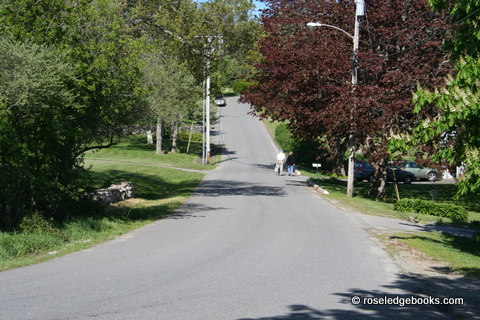
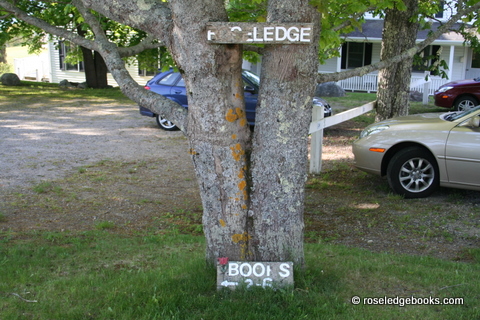
Fig. #28. Already familiar-looking, new rock wall on Sea Street for walkers to enjoy on way to Post Office.
Speaking of which (TH bestsellers), I, in TH, talked to Wayne (in Hawaii but who has been to TH at least twice), who was reading and liking a lot Steven Johnson’s The Ghost Map. Well, I’m reading it, too, and like it so much, I sent it to Charlie (in Seattle, but he started reading it in TH) which is the magic number 3 for a TH bestseller, too. Our reasons for liking the book may differ, but I like that a smart educated-generalist is attacking a riddle — the London cholera epidemic of 1854 — and writing well of his multidisciplinary efforts to solve it, and the long term implications of what he found out about “disease, cities, and scientific inquiry. Every problem needs able generalists attacking its problems, if only to keep the academics awake.
Thirty-seven years ago, my uncle John, when asked if he wanted to read a dissertation, said, “No; researchers too often put the obvious under the microscope and come up with common sense, and I have plenty of that.” I agreed with him then, and, if my reaction to Steven Johnson’s The Ghost Map
The webcam is on, but a bit blurry with rain.

 and Michael Connelly’s
  ). But picky, picky me, I should have read only one at a time. In the second book, which fits with the three-year retirement to return times, there is, all of a sudden, a 6-year-old daughter and her mother. Imagined conception, maybe? And the turmoil, both bureaucratic and inner, seems repetitious. I like Harry enough to wait a while before reading Michael Connelly’s
  , in paperback for the first time.
 , set in upstate New York, I like her a lot, whether she is or not. Police Chief and Episcopalian Priest solve crimes in small town. Think of Anthony Trollope’s
  updated.
 , a hefty NYTimes bestseller. To page 150, I like the learning in it, e.g. intellectual property, cyphers, Shakespeare’s time and life, threads of film and family, but I love most the “research librarian mafia” that undergirds Al’s repertoire of information sources, as he puzzles through the manuscripts. Clearly the author has led an interesting library life. The 435 pages of this trade paperback book are hard to handle with one good hand, which is what I have, so I looked briefly at the
  (Amazon’s ebook device, mentioned favorably by Paul Krugman in his
  and Linda Greenlaw’s
  . Ms. Greenlaw’s book is about Isle Au Haut (Remember Gordon Bok’s song, “The Hills of Isle Au Haut?”), but Coastal small town life and lobsters is more like Tenants Harbor than different. Mr. Woodward’s book doesn’t mention Tenants Harbor on map, in text or index, but he has a good bibliography and discusses at length Monhegan, which is close via Port Clyde, and where, with Tenants Harbor, Jamie Wyeth lives.
 may be helpful. Certainly those of us offering advice about which we knew nothing were not.
 (a biography by Bill Lofy)* on my desk at Roseledge Books is quite exciting.
 for Mary with whom I earlier loved Lillian Beckwith’s books about her years with the crofters on the Hebrides (e.g.
  is next, a book for Elizabeth’s second-year-in-college gift after James Watson’s
  last year, and finally Suzanne Stremper Shea’s
  , a book about bookstores for the group that comes each summer and asks for a Roseledge Books withdrawal read. (By Chapter 9, Sheridan Hay’s
  became more an English major’s novel than a bookstore read.) I love thinking about the readers that special request shelves suggest are near.
 because it was a mystery set in Maine with (I think) a series P.I., Charlie Parker, based in Portland and a NYTimes Bestseller to boot. Surely Roseledge Books should have this. But of the idea of Maine, there was no there there (with apologies to Gertrude Stein on Oakland, CA). Characters are Mainers in name only and the Maine terrain reads like a guidebook embellished by a visit, e.g. the breakfast crowd in The Porthole in Portland or the visit to Supermax in Warren. So Roseledge Books will not have this as a “Maine” book, but maybe I ought to have it as a mystery just to enjoy the argument with a reader who differs.
 . The book was okay, but not special enough to spend time reading about her or Los Angeles. (Montana of the title is an avenue in Los Angeles. I really like the real Montana. Where are you Jamie Lee Harrison?) FBI agent Ana Grey was compared [by NYT Book Review] to Sue Grafton’s Kinsey Millhone, and I’m not that wild about Ms. Millhone either. Maybe it’s the evidence presented in the cases; I like obscure records and aberrant flow of information. Thanks to my sister’s introduction, Michael Connelly’s Harry Bosch has LA covered for me, but few Roseledge Books readers ask for Pacific Ocean seaport reads, though if I have them, they sometimes buy them, e.g. Paul Gauguin’s
  , Captain Bligh’s Log of the HMS Bounty 1787-1789, Dana Stabenow’s
  , an Alaskan crabbing mystery.
 . He “understands the nuances of [the CIA] trade (says George Tenet) and “the world of CIA operations in the Middle East” (says Seymour Hersh). I like him after reading his “seminal” spy novel set in Beirut of the early ‘80’s.
 , which is set among al-Qaeda in the mountains of Pakistan. It was a NYTimes Bestseller, but even better for quality control, it won the Edgar Award.
 , and — hark! — I liked him. He’s not bleak, but he’s no bundle of peppiness, either. He’s dogged, smart, outraged, avoiding his diabetes, willing to risk new friends, and a really good group leader.
 , joins his former military team in a search for the killers of their former colleagues. This is a group of peers, almost interchangeable, hugely trained, and well-experienced nine years earlier. Reacher understands how and when to stand back, take charge or join in.

 ) which is good because Roseledge Books only has a picture-less guide to Maine places where birds might be. But that wasn’t what I meant either.
 , the latest John March paperback mystery. I like John March. I like his decisions, dialogue, NYC detail, and I like author Spiegelman’s continuing background of family, finance, friendships, maybe especially finance. Since Paul Erdman died, I’ve had no one so able to teach me about finance through fiction, and learning about money is part of knowing how the world works — my most major reading goal.
 , though I have liked them until now. And Millie and Kathy both thought Tony Hillerman’s
  , his latest paperback with Jim Chee and Joe Leaphorn, was a little less. So were the last two Stephanie Plum “numbers” by Janet Evanovich. I thought each needed one more escapade, and it’s time to settle the Joe/Ranger issue. Do authors get bored with their characters after a while? I think I remember John Sanford saying he did. Do readers? I do.